
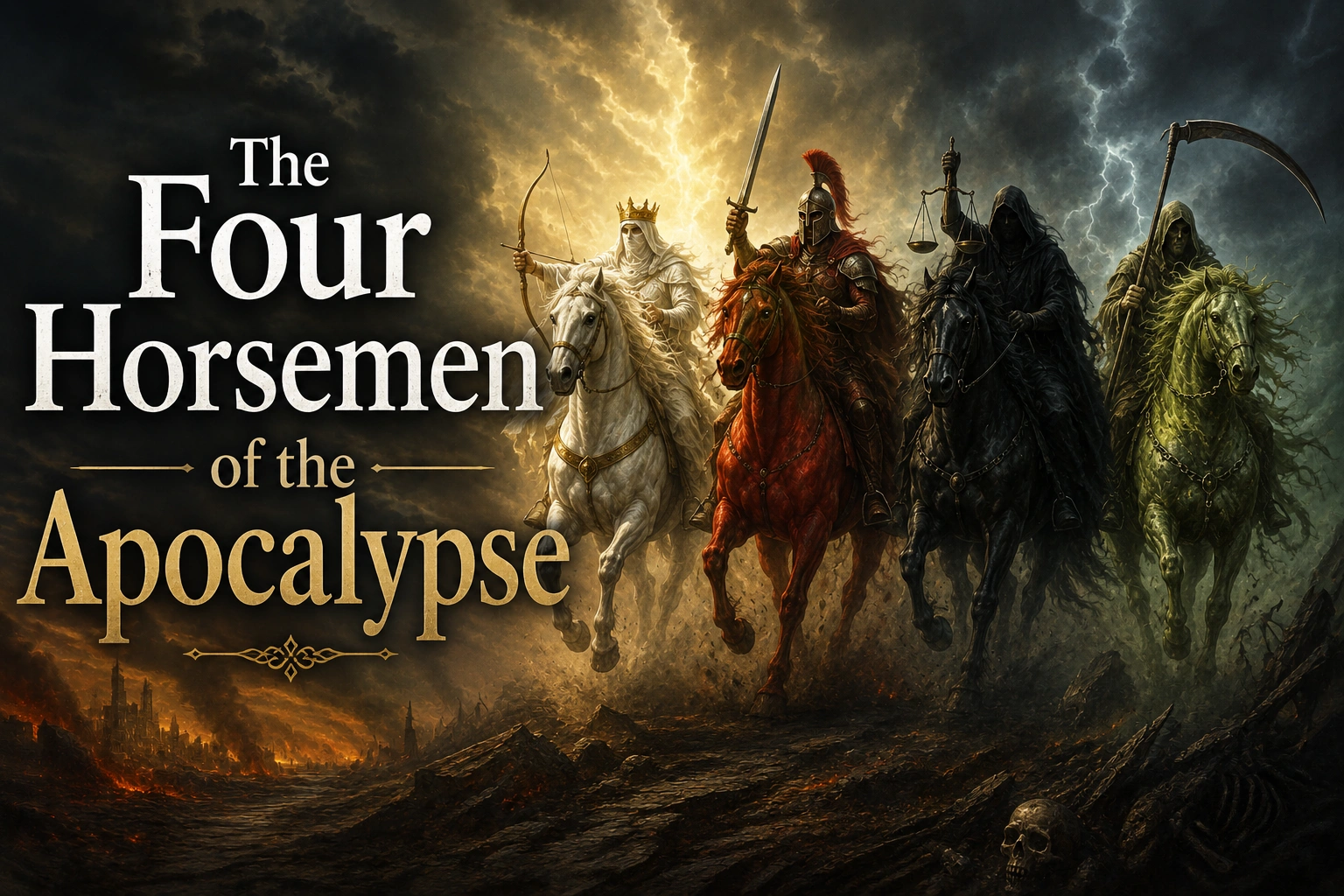
The four horsemen of the apocalypse appear in Revelation 6 when Jesus opens the first four seals of judgment. Each rider represents a different force unleashed on the earth: conquest, war, famine, and death. Christians have debated the exact meaning of these visions for centuries. But all agree on the core truth: God is in control, and Jesus holds every seal.
You’ve probably heard the phrase “four horsemen of the apocalypse” before.
Maybe in a sermon.
Maybe in a movie.
Maybe in a news headline during a rough week in the world.
But what does the Bible actually say about them?
These four riders appear in one of the most dramatic passages in all of Scripture.
They ride out one by one as Jesus opens the first four seals of judgment.
And what they represent has fascinated, challenged, and sometimes unsettled Christians for almost 2,000 years.
In this post, we’ll walk through each horseman, what they symbolize, and what the major Christian traditions say about when and how these visions will be fulfilled.
What Are the Four Horsemen of the Apocalypse?
The four horsemen of the apocalypse are four riders described in Revelation 6:1-8, each released when Jesus opens one of the first four seals of judgment.
They ride a white horse, a red horse, a black horse, and a pale horse.
Together, they represent conquest, war, famine, and death: the forces God releases as part of His end-times judgment on the earth.
That’s the short answer.
But there’s a lot more going on beneath the surface.
The word “apocalypse” doesn’t actually mean catastrophe or destruction.
It comes from the Greek word apokalypsis, which means “unveiling” or “revelation.”
The Book of Revelation is quite literally an unveiling of what God is doing behind the scenes of history.
The horsemen are part of that unveiling.
Where Does This Vision Come From?
To understand the horsemen, you need a quick bit of context.
In Revelation 5, Jesus (described as the “Lamb who was slain”) is handed a scroll sealed with seven seals.
This scroll represents God’s plan for judgment and the renewal of all things.
No one in heaven or earth is worthy to open it except Jesus.
Then, in Revelation 6, He begins opening the seals.
The first four releases are the horsemen.
The next three unlock further judgments, including the seven trumpets that follow in the sequence.
This vision also echoes Zechariah 6:1-8, where four chariots pulled by colored horses go out across the earth as God’s agents.
John’s audience would have recognized that imagery immediately.
The horsemen are part of a much larger pattern of judgment imagery woven through both the Old and New Testaments, including the broader signs of the apocalypse described elsewhere in Scripture.
A Rider-by-Rider Breakdown
Let’s look at each horseman individually.
The First Seal: The Rider on the White Horse
“I looked, and there before me was a white horse. Its rider held a bow, and he was given a crown, and he rode out as a conqueror bent on conquest.” (Revelation 6:2)
The first rider comes out on a white horse, holding a bow and wearing a crown.
He rides out “bent on conquest.”
That phrase alone has kept scholars debating for centuries.
White in Revelation often symbolizes victory, purity, or divine authority.
But a rider with a bow and a crown who conquers doesn’t automatically read as something holy.
We’ll look at the identity debate more closely in a moment.
For now, note that this rider is the first thing released: whatever he represents, he sets everything else in motion.
The Second Seal: The Rider on the Red Horse
“Its rider was given power to take peace from the earth and to make people kill each other. To him was given a large sword.” (Revelation 6:4)
The red horse rider is the least controversial of the four.
Red has always symbolized bloodshed.
This rider is explicitly given a “large sword” and the power to take peace from the earth.
He represents war: violent, widespread, earth-shaking conflict.
The Third Seal: The Rider on the Black Horse
“Its rider was holding a pair of scales in his hand. Then I heard what sounded like a voice among the four living creatures, saying, ‘Two pounds of wheat for a day’s wages, and six pounds of barley for a day’s wages.'” (Revelation 6:5-6)
The black horse rider carries scales.
A voice cries out pricing grain at a full day’s wages for a single meal.
This is famine.
A denarius was the standard day’s wage for a laborer in the Roman world.
For that full day’s pay, you could only buy enough wheat for one person’s daily needs.
Everything else would disappear just trying to eat.
The voice also says “do not damage the oil and the wine,” suggesting the famine hits the poor hardest while the wealthy are somewhat protected.
That social dimension of famine, where the rich survive while the poor suffer most, is something every generation has recognized.
The Fourth Seal: The Rider on the Pale Horse
“Its rider was named Death, and Hades was following close behind him.” (Revelation 6:8)
The fourth horseman is the only one explicitly named: Death.
And Hades, the realm of the dead, follows right behind him.
He is given power over a quarter of the earth, to kill by sword, famine, plague, and wild beasts.
Everything the first three horsemen introduced, Death sweeps up in his wake.
The color of his horse is just as striking as his name.
The Greek word is khloros, the same word used elsewhere in the New Testament to describe green vegetation (Mark 6:39).
But in context, it describes the sickly pallor of a corpse: a greenish-grey color that unsettles rather than inspires.
What Do the Colors of the Four Horses Mean?
The four horse colors in Revelation carry symbolic weight rooted in both biblical imagery and ancient cultural meaning.
White represents conquest or divine authority.
Red represents blood and warfare.
Black represents scarcity, grief, and the grim face of famine.
Pale (from the Greek khloros, meaning sickly green or ashen) represents the pallor of death and plague.
Together, the progression of colors paints a picture of escalating judgment.
Colors in biblical prophecy are never random.
They’re chosen to land in the gut before the mind even processes the explanation.
Who Is the White Horse Rider, Really?
The identity of the white horse rider in Revelation 6 is one of the most debated questions in biblical prophecy.
Two main views exist.
The first holds that he is the Antichrist: a false conqueror who mimics Christ and ushers in the Tribulation.
The second holds that he represents Christ Himself, or the spread of the gospel.
Most evangelical scholars favor the Antichrist interpretation, based on the context of seals as judgment rather than blessing.
Here’s why the debate is so persistent.
Later in Revelation (19:11), Jesus Himself rides a white horse as the conquering King of Kings.
That image is glorious, undeniable, and triumphant.
So when a white horse appears in Revelation 6, it’s natural to think of Jesus.
But the context here is different.
In Revelation 6, the seals represent judgment being poured out on the earth.
The rider holds a bow (not a sword), wears a crown given to him (not one he inherently holds), and rides out to conquer.
These details suggest someone imitating divine authority rather than genuinely possessing it.
The parallel to Matthew 24:4-5, where Jesus warns that “many will come in my name, claiming ‘I am the Messiah’ and will deceive many,” adds weight to the Antichrist interpretation.
That said, some serious scholars, including early church fathers like Irenaeus, believed this rider represented Christ or the victorious advance of the gospel.
It’s a legitimate minority view, not a fringe one.
This is a passage that calls for humility.
How Have Christians Interpreted the Four Horsemen?
Christians have interpreted the four horsemen through four main theological lenses: futurist, preterist, historicist, and idealist.
Each view shapes not just what the horsemen mean, but when they act and who they affect.
Scholars and theologians have wrestled with this passage for nearly two millennia.
Different traditions interpret these riders in genuinely different ways, and all deserve a fair hearing.
Futurist: Events Still to Come
The futurist view holds that the horsemen describe specific events during a coming Tribulation period that has not yet begun.
In this view, the opening of the seals begins only after the church is removed from the earth in the Rapture.
The white horse rider is the Antichrist.
The other three riders represent the global chaos that follows his rise.
This is the most widely held view in American evangelical Christianity.
It forms the backbone of the premillennial timeline taught in most Bible prophecy ministries.
Preterist: Already Fulfilled in History
The preterist view of the end times holds that most of Revelation, including the horsemen, was fulfilled in the first century.
This refers specifically to the Jewish-Roman War and the destruction of Jerusalem in 70 AD.
In this reading, the white horse rider represents the Roman general Vespasian (or Titus), and the other horsemen describe the famine, bloodshed, and death that followed.
Preterists argue this fits the urgency language throughout Revelation, such as “these things must soon take place.”
Idealist: Timeless Spiritual Forces
The idealist (or symbolic) view doesn’t tie the horsemen to any specific historical event, past or future.
Instead, it sees them as representing forces that are always present in a fallen world: the drive for domination, the persistence of violence, the cruelty of scarcity, and the inevitability of death.
This view takes Revelation as a theological drama designed to give persecuted Christians a framework for understanding suffering in any era.
What Do the Four Horsemen Mean for Your Faith Today?
Whatever your theological view, the horsemen are not designed to terrify you.
They’re designed to anchor you.
The Book of Revelation opens by calling itself “the revelation of Jesus Christ.”
From the first verse, the subject is Jesus, not catastrophe.
The horsemen don’t ride out on their own authority.
They ride out because Jesus opens each seal.
He is the one holding the scroll.
He is the one in control.
That matters.
When you watch the news and the world feels like it’s unraveling, the horsemen imagery doesn’t say “chaos has won.”
It says: even this is within God’s sovereign plan.
The seven signs in Revelation and the signs of Jesus’s return aren’t meant to send you into panic.
They’re meant to keep you watchful, rooted, and hopeful.
The last horseman carries Death.
But even Death doesn’t get the final word in Revelation.
Jesus does.
Go Deeper in End Times Scripture with Seeker of Christ
If the four horsemen have sparked more questions than answers, you’re in good company.
Revelation is one of the most searched and debated books in the Bible.
At Seeker of Christ, we write about these topics the way you’d want a trusted friend to explain them: clearly, honestly, and without the fear-mongering.
You might want to explore what the signs of the apocalypse look like according to Scripture.
Or get a complete breakdown of the seven signs in Revelation.
You can also go deeper into the preterist view of the end times if that interpretation caught your attention.
Have a question we haven’t answered?
Submit it through our contact form.
We read every message, and we love hearing from readers who are digging into Scripture.
FAQs About the Four Horsemen
What are the names of the four horsemen of the apocalypse?
The Bible doesn’t give the first three horsemen personal names. Only the fourth is explicitly named: Death. The others are identified by their horses’ colors and what they represent: conquest (white), war (red), and famine (black). Popular culture has assigned names like Conquest, War, Famine, and Death, but these come from artistic tradition, not Scripture.
What does the white horse represent in Revelation?
The white horse in Revelation 6 carries a rider who goes out to conquer. Most evangelical scholars interpret this rider as the Antichrist, a counterfeit Christ who brings false peace at the start of the Tribulation. A minority view holds the rider represents Christ Himself or the advance of the gospel. The debate hinges on context: the other seals all bring judgment, making a positive interpretation of the white horse harder to sustain.
Is the pale horse the same as the green horse?
In a sense, yes. The Greek word for the pale horse’s color is khloros, which literally means green or yellowish-green. It’s the same word used elsewhere in the New Testament to describe green grass. In context, it refers to the sickly pallor of a corpse, not lush vegetation. Translators typically render it “pale” to capture that meaning in English.
Are the four horsemen happening right now?
Futurists would say no: the horsemen are released during a specific Tribulation period that hasn’t begun yet. Preterists would say no in a different sense: they already happened in the first century. Idealists might say that the forces the horsemen represent (conquest, war, famine, death) are always present in a fallen world. What most Christians agree on is that God is still sovereign over all of it.
Do the four horsemen appear anywhere in the Old Testament?
A direct parallel appears in Zechariah 6:1-8, where four chariots pulled by horses of different colors go out across the earth as “the four spirits of heaven.” Scholars widely believe John’s vision in Revelation 6 draws on this imagery deliberately. The Old Testament echoes give the four horsemen deeper roots than just one passage in Revelation.
What is the order of the four horsemen?
The order is: white horse (conquest), red horse (war), black horse (famine), and pale horse (death). They are released in this sequence as Jesus opens the first, second, third, and fourth seals in Revelation 6:1-8.
What happens after the four horsemen are released?
After the fourth seal, Jesus opens the fifth seal, revealing the souls of martyrs who cry out for justice. The sixth seal brings cosmic disturbances: earthquakes, a darkened sun, stars falling from the sky. Then come the seven trumpets, which bring further judgments on the earth.