
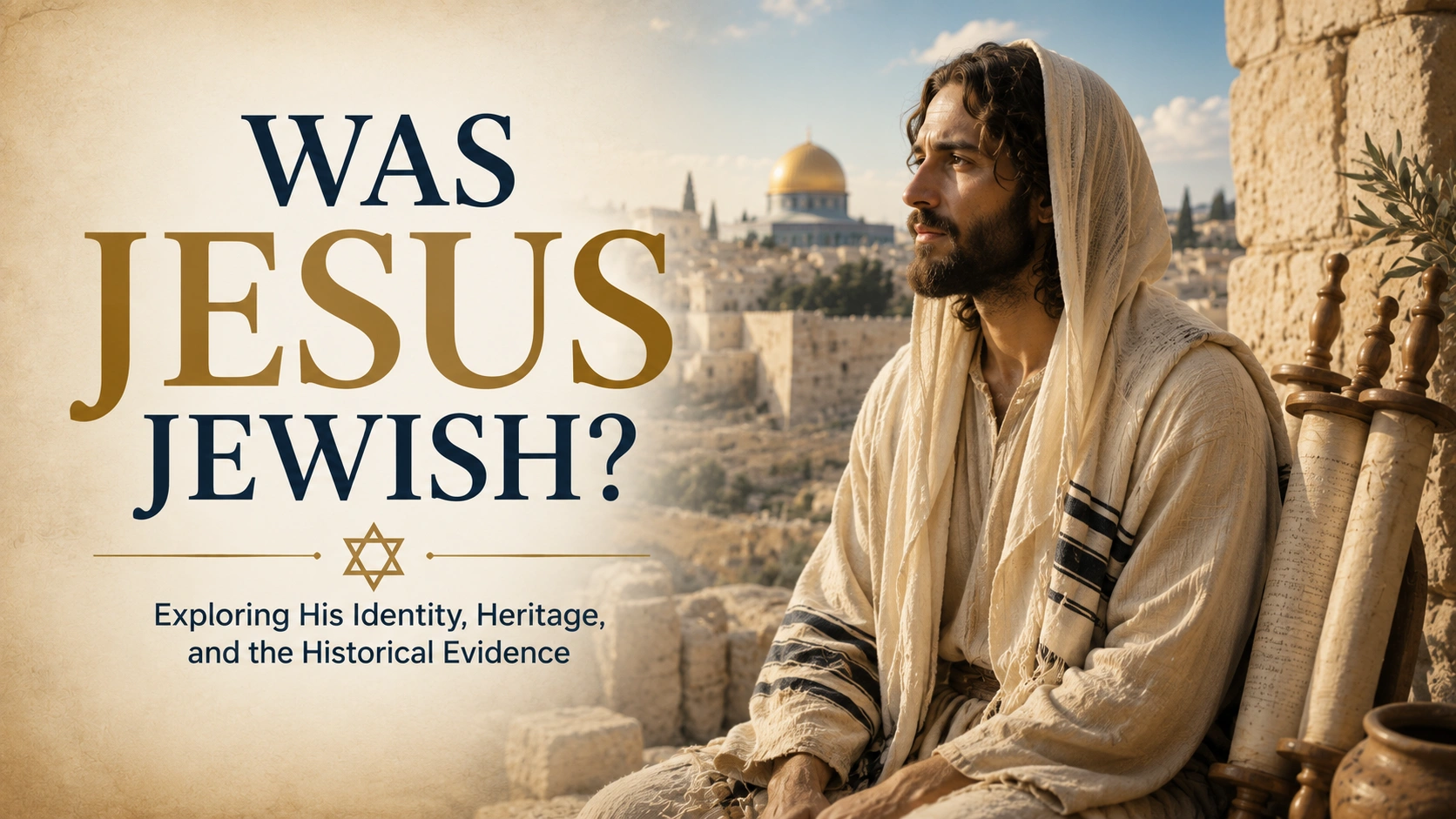
Jesus was Jewish by birth, by upbringing, and by practice. He was circumcised on the eighth day, presented at the Temple, and raised by a Jewish family in Galilee that kept the festivals and attended synagogue. Ethnically, he was a Galilean Jew of Middle Eastern, Semitic appearance, not the pale, European figure common in Western art. Christianity emerged later, but Jesus himself lived and died a practicing Jew.
“Was Jesus Jewish?” It’s an interesting question that trips people up.
Somewhere between Sunday school flannel boards and centuries of European art, many Christians picture Jesus as, well, not particularly Jewish at all.
But the historical and biblical record is clear on this point.
Jesus was born, raised, and died a Jew, and understanding that fact changes how you read almost every page of the Gospels.
This isn’t a minor detail Christians can skip past.
Jesus’s Jewish identity shapes his teaching, his conflicts with religious leaders, his understanding of Scripture, and even the promises God made centuries earlier.
Let’s look at what the Bible and history say about who Jesus was, starting with the most basic question: was Jesus a Jew?
Was Jesus Jewish?
Yes, Jesus was Jewish.
He was born to a Jewish mother, circumcised according to Jewish law on the eighth day, raised by observant Jewish parents in Galilee, and recognized throughout his ministry as a Jewish teacher, or rabbi.
Every major source on his life, the Gospels included, places him firmly inside first-century Jewish culture and religion.
The Gospel of Luke records that Mary and Joseph took him to Jerusalem “to present him to the Lord” according to the Law of Moses (Luke 2:22).
That single detail tells you a lot.
Jesus’s parents weren’t loosely spiritual people borrowing from Jewish customs.
They were following the Torah, the same way any devout Jewish family in first-century Judea would have.
Jesus grew up speaking Aramaic, studying Hebrew Scripture, and living under Jewish law.
He taught in synagogues (Luke 4:16), quoted the Torah and the Prophets constantly, and was addressed as “rabbi” by his own followers (John 1:38).
None of this is a side note to who Jesus was.
It’s the foundation.
What Ethnicity Was Jesus?
Jesus was a Galilean Jew of Middle Eastern, Semitic descent, not the fair-skinned, light-haired figure so common in Western paintings.
Forensic reconstructions and historical scholarship describe him as most likely having olive or tanned skin, dark eyes, and dark hair, consistent with other Jewish people living in first-century Judea and Galilee.
In 2002, a forensic anthropologist worked with archaeologists to reconstruct the face of a typical first-century Galilean man, using real Semite skulls found near Jerusalem. The resulting reconstruction showed a wide face, dark eyes, short dark hair, and tanned skin, nothing like the pale, light-haired figure so often painted centuries later.
It’s worth being careful here too.
Modern ideas about “race” don’t map cleanly onto the ancient world.
First-century people identified each other by nation, tribe, and religion, not by the racial categories we use today.
When historians talk about Jesus’s ethnicity, they’re really talking about his identity as a Judean, a Galilean, and a Jew, not a skin-color chart.
He wasn’t an outsider walking into Jewish life.
He was already fully part of it.
This ties closely into a related question worth exploring: what does God look like, and how Scripture handles physical descriptions of the divine very differently than it handles Jesus’s real, human, Jewish body.
How Jesus’s Jewish Family Raised Him
Jesus was raised according to Jewish law and custom from his earliest days, including circumcision on the eighth day, presentation at the Temple, and a childhood shaped by synagogue attendance, festival observance, and Torah study.
His parents, Mary and Joseph, are consistently described in the Gospels as devout, law-observant Jews.
Circumcision and Presentation at the Temple
Luke’s Gospel records that Jesus “was circumcised” on the eighth day, in keeping with the covenant God made with Abraham (Luke 2:21).
Shortly after, his parents brought him to the Temple in Jerusalem to be presented to the Lord and to offer the sacrifice required by the Law (Luke 2:22-24).
These weren’t symbolic gestures.
They were the same steps any Jewish family in that period would take for a newborn son.
Synagogue, Festivals, and a Likely Bar Mitzvah
As Jesus grew older, the Gospels describe him attending synagogue “as was his custom” (Luke 4:16), a phrase that implies a lifelong habit, not an occasional visit.
Luke also records a trip to Jerusalem for Passover when Jesus was twelve, where he was found in the Temple “sitting among the teachers, listening to them and asking them questions” (Luke 2:46).
Given his age and the Jewish customs of the time, many scholars believe Jesus likely went through a bar mitzvah-era rite of passage into religious adulthood, even though the formal bar mitzvah ceremony practiced today developed later.
Jesus’s adult ministry followed the same rhythm.
He observed the Sabbath, though he challenged the way many religious leaders interpreted it, and he traveled to Jerusalem for major festivals, including Passover, where the events of his crucifixion took place.
Understanding what the Sabbath actually required under Jewish law helps explain why so many of Jesus’s conflicts with the Pharisees centered on how, not whether, to keep it.
What Jesus’s Genealogy Reveals About His Jewish Roots
Both Matthew and Luke open their accounts of Jesus’s life with a genealogy, and both trace his ancestry through Jewish lines.
Matthew begins his Gospel by connecting Jesus to Abraham and King David (Matthew 1:1-16), tying him directly to God’s covenant promises to the Jewish people.
Luke traces a similar line, though his genealogy reaches back further, all the way to Adam (Luke 3:23-38).
These genealogies matter for more than record-keeping.
They root Jesus firmly inside Jewish history and messianic expectation.
The promise that a descendant of David would establish an everlasting kingdom (2 Samuel 7:12-13) only makes sense in a Jewish context, and Matthew’s Gospel in particular was written to show Jewish readers that Jesus fulfilled exactly that promise.
This is also where the continuity between the Old and New Testaments becomes so important.
Jesus isn’t a new story bolted onto an old one.
He’s presented as the fulfillment of promises made throughout the Old Testament, a Jewish Messiah answering Jewish hopes.
Did Jesus Practice Judaism His Whole Life?
Yes.
Jesus practiced Judaism from birth until his death.
He kept the festivals, taught in synagogues, debated fellow Jewish teachers about how to interpret the Law, and observed Jewish customs even in his final days, including the Passover meal he shared with his disciples the night before his crucifixion.
The Last Supper itself was a Passover meal (Luke 22:7-8, 14-15), one of the most sacred observances in Jewish life.
Jesus didn’t set it aside or replace it with something unrelated.
He reframed it, giving new meaning to the bread and cup while still operating firmly within the Passover tradition his family had kept every year of his life.
Even his arguments with religious leaders reflected internal Jewish debate, not a rejection of Judaism.
His disagreements with the Pharisees over Sabbath rules, purity laws, and divorce mirror the kinds of debates found among other Jewish teachers of the period. Jesus’s disputes with the Pharisees and Sadducees reflect the internal diversity of Second Temple Judaism rather than a break from it.
He was arguing as a Jew, to other Jews, about how to faithfully live out the Law.
Why Do People Think Jesus Wasn’t Jewish?
Many people picture Jesus as something other than Jewish because of centuries of European religious art, a history of Christian teaching that downplayed his Jewish identity, and a natural tendency to picture Jesus as looking like the people around us.
None of these reasons hold up historically.
Some of this goes back further than casual assumption.
In the 19th century, certain German theologians tried to separate Jesus from his Jewish context entirely, arguing for his supposed “uniqueness” apart from Judaism in ways that later contributed to antisemitic ideology, including the disturbing “Aryan Jesus” propaganda used by the Nazi regime.
That history is a sober reminder of why getting this right actually matters, not just historically, but morally.
On a much smaller scale, the same instinct shows up in art and film.
Painters throughout history tended to depict Jesus with the features of their own culture, whether that meant Italian, Dutch, or later American depictions.
None of those images were meant maliciously, but they created a mental picture of Jesus that has little to do with a first-century Galilean Jew.
How Christianity Grew Out of Jesus’s Jewish World
Christianity didn’t begin as a separate religion.
It started as a movement within Judaism, led by Jewish followers of a Jewish Messiah.
The earliest Christians, including all twelve apostles, were Jewish, and they continued attending synagogue and observing Jewish customs for years after Jesus’s resurrection.
The split between what became Christianity and mainstream Judaism happened gradually, over decades, as more Gentiles joined the movement and Jewish religious leaders rejected the claim that Jesus was the Messiah.
Even the Gospels themselves, foundational texts of the Christian faith, were written by Jewish authors working within a Jewish framework, drawing on Hebrew Scripture to explain who Jesus was and why he mattered.
Over the following centuries, Christianity spread far beyond its Jewish origins and developed into many different branches and traditions, including the many groups that eventually formed what most people recognize as the difference between Catholic and Protestant Christianity.
But that later development doesn’t change the fact that the movement’s founder lived and died within Judaism, not apart from it.
Keep Exploring Who Jesus Really Was
At Seeker of Christ, questions like this one are exactly why the site exists.
Understanding Jesus’s Jewish identity isn’t a side project.
It changes how the whole story reads, from the promises made to Abraham to the words Jesus spoke in the Temple courts.
If this raised more questions than it answered, that’s a good sign, not a problem.
Faith tends to grow through honest questions, not around them. Learning to trust the reliability of the Gospel accounts is a natural next step for anyone digging deeper into who Jesus actually was and what he taught.
You can also sign up for the Seeker of Christ newsletter for new articles like this one, sent straight to your inbox as new questions get tackled.
Lastly – remember that Jesus is the Son of God, who came down from heaven to die for each and every one of us, whether Jew or Gentile. He loves each of us, regardless of ethnicity or background.
Jesus Christ is the Messiah, and faith in him is what matters most here.
Frequently Asked Questions
Was Jesus a Jew or a Christian?
Jesus was a Jew, not a Christian in the sense we use that word today. He lived, taught, and died within Judaism, and the term “Christian” was not even used until years after his death, when it first described his Jewish and Gentile followers in Antioch (Acts 11:26).
What ethnicity was Jesus?
Jesus was ethnically a Galilean Jew of Middle Eastern, Semitic background, most likely with olive or tanned skin, dark eyes, and dark hair, consistent with other Jewish people living in first-century Judea and Galilee rather than the fair-skinned depictions common in later European art.
Did Jesus ever stop being Jewish?
No, Jesus never stopped being Jewish. He kept Jewish law, observed Jewish festivals, and even ate a Passover meal the night before his crucifixion, remaining a practicing Jew from birth through death.
Why do some paintings show Jesus as European?
Paintings often reflect the culture of the artist rather than historical accuracy, and for centuries European painters depicted Jesus with the features of their own communities instead of the Middle Eastern, Jewish appearance historians associate with a first-century Galilean man.
Did Jesus celebrate Jewish holidays?
Yes, Jesus celebrated Jewish holidays throughout his life, including Passover, which he traveled to Jerusalem to observe every year, and the Gospels also describe him at the Temple during other Jewish festivals.
Why did Christianity separate from Judaism if Jesus was Jewish?
Christianity separated from mainstream Judaism gradually, over several decades, as more Gentile believers joined the movement and Jewish religious authorities rejected the claim that Jesus was the Messiah, not because Jesus himself abandoned his Jewish identity or practice.