
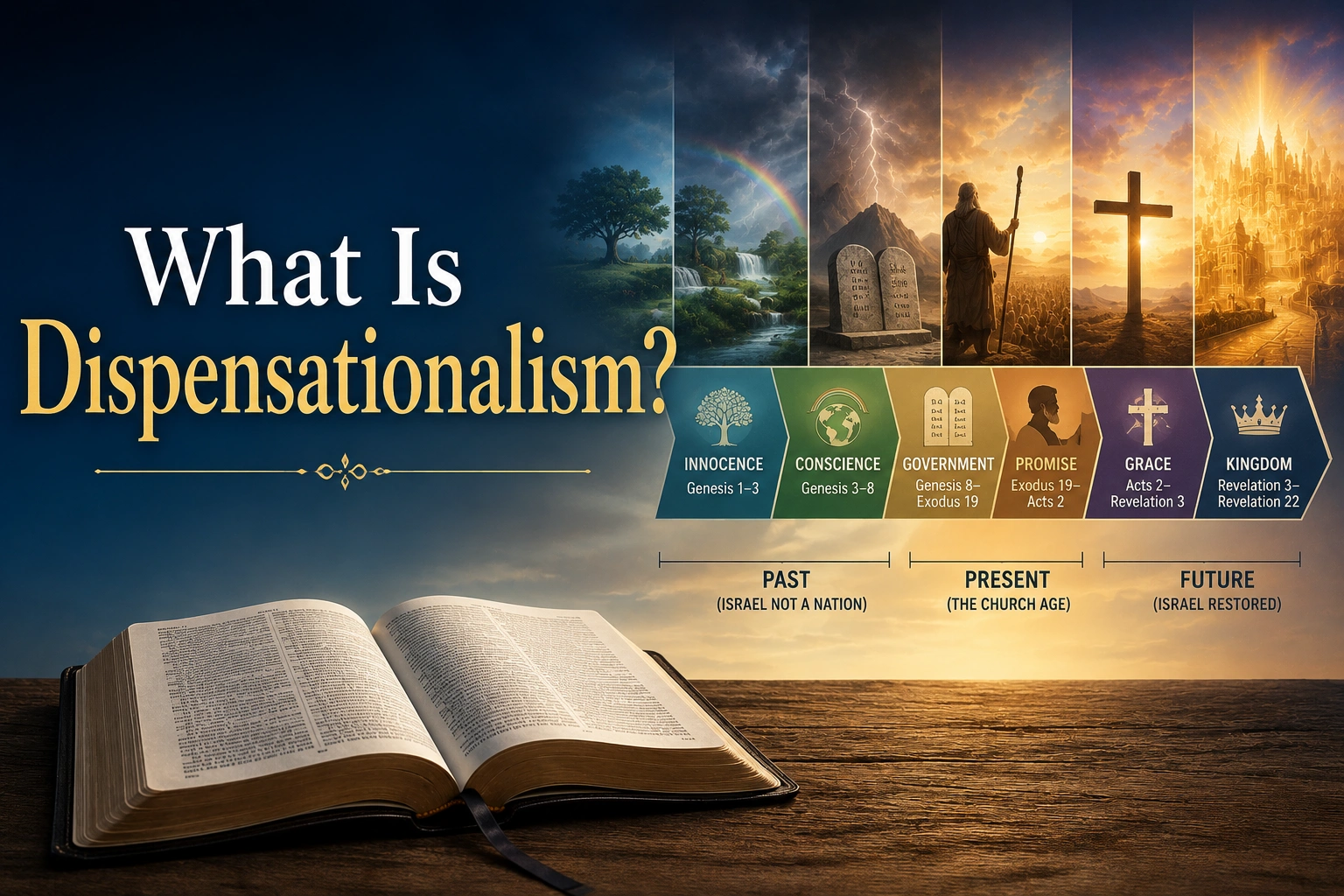
Dispensationalism is a way of reading the Bible that divides history into distinct periods called “dispensations,” each representing a different arrangement between God and humanity. Developed in the 1800s by theologian John Nelson Darby, it became one of the most influential theological systems in evangelical Christianity. It’s best known for its teaching on the rapture and a literal 1,000-year reign of Christ. This guide explains exactly what it teaches, where it came from, and what the Bible actually says.
If you’ve spent time in evangelical churches, you’ve probably heard words like “the rapture,” “the tribulation,” or “the millennial kingdom.”
A lot of that language comes from one theological system: dispensationalism.
But what actually is it?
And why do so many Christians disagree about it?
This guide breaks it all down in plain English. No seminary degree required.
What Is Dispensationalism? (A Simple Definition)
Dispensationalism is a theological framework that reads the Bible as a story divided into distinct periods of time called “dispensations.”
In each period, God relates to humanity in a specific way, with different rules, responsibilities, and expectations.
The word “dispensation” comes from the Greek word oikonomia, which means stewardship or management, like a household manager overseeing different tasks in different seasons.
Paul uses this exact word in Ephesians 1:10, referring to God’s plan for “the fullness of times.”
Dispensationalists believe these periods show how God progressively revealed his plan across history, from Adam and Eve in the garden all the way to the future millennial kingdom.
Two core convictions hold the whole system together.
First, the Bible should be interpreted literally, especially prophecy.
Second, Israel and the Church are two distinct groups in God’s plan, not one continuous people.
Everything else in dispensationalism flows from these two ideas.
Where Did Dispensationalism Come From?
Dispensationalism as a formal system was developed by John Nelson Darby (1800–1882), an Irish theologian and founding member of the Plymouth Brethren movement.
Darby didn’t invent the idea of biblical ages, as earlier thinkers had divided Scripture into periods.
But he was the first to build a comprehensive system around it, including the teaching that the Church would be “raptured” (removed from earth) before a final period of tribulation.
His ideas crossed the Atlantic and took root in the United States.
The pivotal moment came in 1909, when Cyrus Ingerson Scofield published the Scofield Reference Bible, a King James Bible with dispensationalist commentary printed right alongside the text.
It sold millions of copies and introduced an entire generation of American evangelicals to the framework.
Dallas Theological Seminary, founded in 1924, became the academic home of dispensationalist scholarship.
Scholars like Charles Ryrie, John Walvoord, and J. Dwight Pentecost refined and systematized the theology throughout the 20th century.
By the time Hal Lindsey published The Late Great Planet Earth in 1970, dispensationalist ideas had reached mainstream culture and shaped how millions of Christians understood the end times.
What Are the 7 Dispensations in the Bible?
Dispensationalists traditionally identify seven distinct eras in Scripture.
Each one represents a period where God set specific terms for his relationship with humanity, and where humanity ultimately failed to meet those terms.
Here’s a quick overview of each.
- 1. Innocence (Genesis 1–3): Adam and Eve in the Garden of Eden, living under a single command. Ended with the Fall.
- 2. Conscience (Genesis 3–8): Humanity governed by moral conscience. Ended with Noah’s flood.
- 3. Human Government (Genesis 9–11): God delegated authority to human structures after the flood. Ended at Babel.
- 4. Promise (Genesis 12–Exodus 19): God’s covenant with Abraham and his descendants. Ended with the giving of the Law at Sinai.
- 5. Law (Exodus 20–Acts 2): Israel governed by the Mosaic Law. Ended with the death and resurrection of Christ and the coming of the Holy Spirit.
- 6. Grace (Acts 2–Revelation 20): The current Church age. Salvation is by faith in Christ, not by works of the Law.
- 7. Millennial Kingdom (Revelation 20): A future 1,000-year reign of Christ on earth, fulfilling Old Testament promises to Israel.
As Paul writes in Galatians 3:24-25, the Law served as a guardian “until Christ came.”
It’s important to note: dispensationalists do not teach that people were saved differently in each era.
Salvation has always been by faith.
The dispensations describe different administrations, not different paths to God.
What Does Dispensationalism Actually Teach?
Literal Interpretation of Scripture
Dispensationalism insists on reading the Bible literally, especially prophecy.
Where most theological systems allow for symbolic or spiritualized readings of Old Testament prophecy, dispensationalists argue those promises mean exactly what they say.
If God promised land to Israel, he means literal land.
If Revelation describes a 1,000-year reign, it means a literal 1,000 years.
This commitment to literal interpretation shapes every other doctrine in the system.
Israel and the Church Are Two Separate Groups
This is the most defining feature of dispensationalism.
Covenant theology, the main alternative system, teaches that the Church is the continuation of Israel: the same people of God across both testaments.
Dispensationalism strongly disagrees.
Dispensationalists argue that God has two distinct peoples: ethnic Israel and the Church.
Israel’s promises, including the land, the throne of David, and a national kingdom, are still future and literal.
The Church, made up of Jewish and Gentile believers in this age, is a separate entity with different promises and purposes.
This is why dispensationalism has historically led to strong support for the modern state of Israel, as many adherents see its existence as a fulfillment of biblical prophecy.
The Rapture, Tribulation, and Millennial Kingdom
Dispensationalism is where the modern concept of a pre-tribulation rapture comes from.
The teaching goes like this: before a seven-year period of global tribulation described in Daniel and Revelation, Christ will “rapture,” or suddenly remove, the Church from the earth.
Then the tribulation unfolds.
Then Christ returns visibly to establish a literal premillennial reign and rule for 1,000 years.
Paul describes the catching up of believers in 1 Thessalonians 4:16-17: “the dead in Christ will rise first. After that, we who are still alive and are left will be caught up together with them in the clouds to meet the Lord in the air.”
Whether that event happens before, during, or after a tribulation period is where Christians disagree, but dispensationalism firmly places it before.
If you want to go deeper into what the Bible says about the rapture, that’s worth exploring as a next step.
Is Dispensationalism Biblical?
This is the question most readers are actually asking.
Dispensationalism is a theological system, not a direct quote from Scripture.
Like all theological frameworks, it’s an attempt to organize and explain what the Bible teaches.
That means it can, and should, be evaluated against Scripture.
What it gets right: the Bible does describe different eras with distinct covenants and commands.
God’s relationship with Abraham was different from his relationship with Moses, which was different again from the New Covenant in Christ.
The idea of progressive revelation, that God revealed his plan in stages, is well-supported throughout the Old Testament and New Testament.
Where it faces challenges: critics, especially from covenant theology, argue that key passages suggest a single continuous people of God rather than two separate tracks.
In Romans 11:17-24, Paul describes Gentiles being grafted into Israel’s olive tree, implying one unified tree rather than two separate programs.
And in Ephesians 2:14, Paul writes that Christ “has made the two groups one” by breaking down the dividing wall between Jew and Gentile.
The honest answer is that this is a genuine debate among Bible-believing, gospel-centered Christians.
Dispensationalism is not heresy.
It affirms the core doctrines of the faith: the authority of Scripture, salvation by grace through faith, the resurrection, and the return of Christ.
What it represents is a particular interpretive framework for reading prophecy and the relationship between Israel and the Church.
Faithful Christians have held different views on this for centuries.
Dispensationalism vs. Covenant Theology
Dispensationalism and covenant theology are the two dominant frameworks for reading the Bible’s big story, and they reach different conclusions on several key points.
Covenant theology sees God’s redemptive plan as unified around three overarching covenants: redemption, works, and grace.
The Church is the continuation and fulfillment of Old Testament Israel.
Old Testament prophecies about Israel are largely fulfilled in Christ and the Church, often interpreted spiritually rather than literally.
Dispensationalism, by contrast, sees God’s plan unfolding through distinct historical periods.
Israel and the Church are separate.
Old Testament promises to Israel are still literally future.
The Church age is sometimes described as a kind of parenthesis between God’s past and future dealings with Israel.
A third option, progressive covenantalism, has grown in recent years as a middle ground.
It affirms a unified storyline while acknowledging more distinction between Israel and the Church than covenant theology typically allows.
All three systems are held by serious, Scripture-loving Christians.
Understanding them helps you see why believers who agree on the gospel can still disagree on questions like the rapture, Israel’s future, and the millennium.
Three Types of Dispensationalism
Classic Dispensationalism
This is the original form associated with Darby and the Scofield Reference Bible.
It emphasizes sharp distinctions between Israel and the Church, a strictly literal hermeneutic, and a pre-tribulation rapture position.
Some classic dispensationalists taught that Israel and the Church have entirely separate eternal destinies, a view most later dispensationalists have stepped back from.
Revised Dispensationalism
Developed by scholars at Dallas Theological Seminary in the mid-20th century, revised dispensationalism maintains the Israel-Church distinction and the pre-trib rapture.
But it softens some of the sharper distinctions of the classic form and places more emphasis on the unity of God’s redemptive plan.
This is the most widely held form in evangelical churches today.
Progressive Dispensationalism
A more recent development from the 1990s, progressive dispensationalism moves closer to covenant theology on some key points.
It argues that the kingdom of God has already begun in Christ’s resurrection and ascension, even while awaiting full and final fulfillment.
This view has attracted a growing number of younger evangelical theologians who want to hold the Israel-Church distinction without the harder edges of the older systems.
What Dispensationalism Means for How You Read Your Bible
If you’ve grown up in an evangelical or Baptist church, you’ve probably absorbed dispensationalist assumptions without knowing it.
The idea that the Church is “not under the Law.”
The distinction between the rapture and the second coming as two separate events.
The belief that current events in the Middle East carry prophetic significance.
The expectation of a literal 1,000-year kingdom, described in Revelation 20:4-6. All of these trace back to a dispensationalist reading of Scripture.
Understanding the system helps you become a more informed reader of the Bible.
It helps you see why some passages that seem to point in different directions, like Old Testament promises of land to Israel and New Testament passages about the Church, are handled so differently by different Christians.
You can look at passages about the signs of Jesus’ return or the meaning of the kingdom of God with much more clarity once you understand the interpretive frameworks behind them.
And if you’ve encountered the preterist view of end times and wondered why it feels so different from what you’ve heard in church, this is exactly why.
Different interpretive frameworks produce dramatically different readings of the same passages.
Explore More Theology at Seeker of Christ
At Seeker of Christ, our goal is simple: bring the Word of God to everyone, everywhere, in language anyone can understand.
Dispensationalism doesn’t exist in isolation.
It connects to some of the biggest questions in Christian theology, including the rapture, the tribulation, the millennium, Israel’s future, and how the Old and New Testaments fit together.
If this post raised more questions, here’s where to go next.
If the rapture question sparked your curiosity, our article on the rapture walks through the key passages and the main positions Christians hold.
If you want to understand the broader end-times debate, our breakdown of premillennialism covers the key positions and what separates them.
If you’re wondering what to make of current events and biblical prophecy, our article on the signs of Jesus’ return walks through what Scripture actually says.
And if you want to understand the relationship between the Old and New Testaments at a foundational level, we’ve covered the differences between the two testaments in depth.
Final Thoughts
Dispensationalism is one of the most influential theological systems in modern evangelical Christianity.
Whether you fully embrace it, hold it loosely, or land in a different framework entirely, understanding it makes you a better-equipped student of the Bible.
It’s not a salvation issue.
Christians who believe in a pre-trib rapture and Christians who don’t are equally saved by grace through faith in Jesus Christ.
What it is, is a framework: a way of organizing what the Bible teaches about history, Israel, the Church, and the end times.
And like any framework, it deserves to be examined with an open Bible in hand.
If you’re on a journey to understand Scripture more deeply, Seeker of Christ is here for every question along the way.
Frequently Asked Questions About Dispensationalism
Who created dispensationalism?
Dispensationalism was systematized by John Nelson Darby (1800–1882), an Irish theologian and founding figure of the Plymouth Brethren movement. While earlier thinkers had divided biblical history into ages, Darby was the first to build a comprehensive dispensationalist system, including the pre-tribulation rapture doctrine. His ideas were later popularized in America through the Scofield Reference Bible (1909).
What are the 7 dispensations in the Bible?
The seven dispensations are: (1) Innocence, covering Adam and Eve before the Fall; (2) Conscience, from the Fall to Noah’s flood; (3) Human Government, from Noah to Babel; (4) Promise, from Abraham to Moses; (5) Law, from Moses to Christ; (6) Grace, the current Church age; and (7) the Millennial Kingdom, a future 1,000-year reign of Christ. Each represents a distinct era in God’s administration of his plan.
Is dispensationalism the same as premillennialism?
They’re closely related but not identical. Premillennialism is the belief that Christ will return before a literal 1,000-year reign on earth. Dispensationalism is a broader theological system that includes premillennialism as one of its components, along with the Israel-Church distinction and the pre-tribulation rapture. You can be a premillennialist without being a dispensationalist, but dispensationalists are always premillennialists.
What does dispensationalism say about Israel?
Dispensationalism teaches that ethnic Israel and the Church are two distinct groups in God’s redemptive plan. God’s promises to Israel, including the land and a future national kingdom, are literal and still awaiting fulfillment. This view sees the modern state of Israel as prophetically significant and has led many dispensationalists to strong support for Israel in global affairs.
Do all evangelicals believe in dispensationalism?
No. Dispensationalism is influential in evangelical circles, especially in Baptist, Pentecostal, and non-denominational churches, but it is not universal. Reformed and Presbyterian churches typically follow covenant theology, which reaches different conclusions about Israel, the Church, and end-times prophecy. Progressive covenantalism has also grown as a third option among younger evangelical scholars.
What is the difference between dispensationalism and covenant theology?
Dispensationalism divides biblical history into distinct periods (dispensations) and maintains that Israel and the Church are separate peoples with different promises. Covenant theology sees one continuous people of God across both testaments, unified by God’s covenant of grace. The two systems read the same Bible differently, especially when it comes to Old Testament prophecy and the book of Revelation.
Is dispensationalism considered heresy?
No. Dispensationalism is a mainstream theological framework within evangelical Christianity. While it has critics, even strong critics, within the church, it affirms all the core doctrines of the faith: the authority of Scripture, the Trinity, salvation by grace through faith, the bodily resurrection of Christ, and his physical return. The debate over dispensationalism concerns interpretive frameworks, not the fundamentals of salvation.